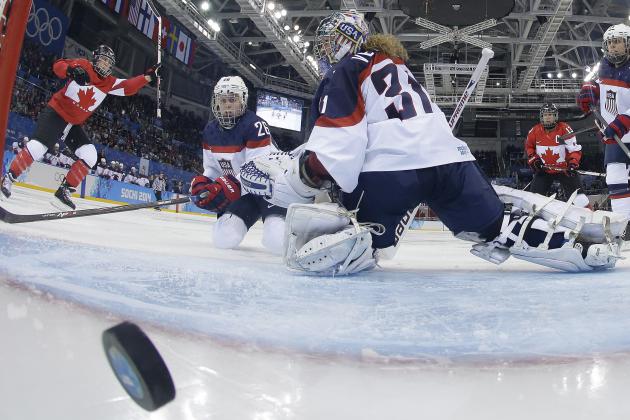
Hockey Olympic or otherwise isn't just for men.
At least, not anymore.
Teams USA and Canada are proving that women can be just as quick and hard-hitting as their male counterparts.
Both teams came in to Wednesday's game riding an undefeated Olympic streak for the year. Canada had recorded two shutouts against Switzerland and Finland, while USA had a 3-1 win over Finland and a decisive 9-0 shutout against Switzerland.
Though both teams are arguably the two best women's hockey teams this year, there is no such thing as a little friendly competition between the two.
The battle and rivalry between the two North American teams is heated, to say the least.
In December, a brawl broke out during a U.S. vs. CAN game. There was definite hostility, and it wasn't even the Olympics.
Jen Neale, writing for Yahoo!'s Puck Daddy, had it right when she wrote:
If anyone says female hockey players aren't tough like the guys, you have been officially dared to drop gloves with one of them at the rink.
On Wednesday, the competition continued in search of the gold, and the intensity grew as Canada rallied back from a 1-0 deficit in the third.
Sallie Jenkins of the Washington Post summarized the intensity of the game this way:
It was supposedly a meaningless game, just an appetizer, because both teams already had byes into the semifinals. But there was nothing casual about it as they shouldered each other into the walls and the momentum swung back and forth.
Results complaints aside, Canada left as the only undefeated team in Group A (Sweden and Russia remain undefeated in Group B).
Watching these two teams play throws every female stereotype out the window. The players move quickly, think fast and hit hard. They compete just as hard as the men.
ESPN reported that professional football was the most popular sport in America for the 30th year in a row:
In 2014, 35 percent of fans call the NFL their favorite sport, followed by Major League Baseball (14 percent), college football (11 percent), auto racing (7 percent), the NBA (6 percent), the NHL (5 percent) and college basketball (3 percent).
Not one mention of women's sports. The only thing that comes close is auto racing, where Danica Patrick is breaking barriers. Otherwise, it's nothing but males.
In a nation where men's sports are the front-runners in popular sports, the U.S. women's hockey team is making a case for women's sports everywhere.
This blog is sponsored by: http://visitwebpages.info/paypalchecks
Showing posts with label Hockey. Show all posts
Friday, February 14, 2014
Thursday, February 13, 2014
Russia vs. Slovenia: TV Info, Live Stream and More for Olympics Hockey 2014
The Slovenian hockey team couldn't have been thrilled upon discovering their opening opponent for the 2014 Olympics.
I mean, on this kind of stage it is best not to worry about the opponent as much as just focusing on playing well as a team. That said, drawing Russia to begin the Olympic journey is not a favorable starting point.
The Russians haven't won a hockey Olympic medal since 2002, and the 2010 team was such a disappointment that it was addressed at the regional parliament of the Siberian city of Tomsk.
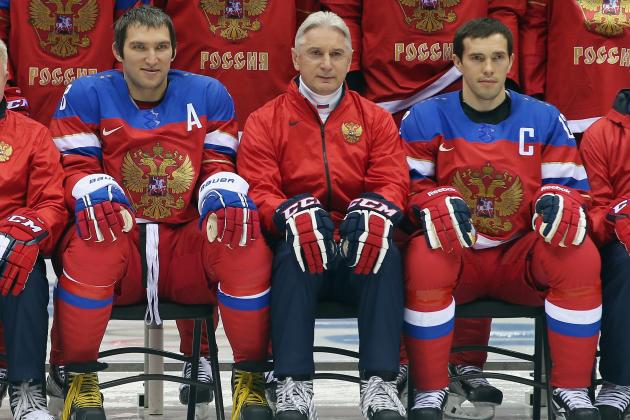
The Russians really want this gold. The team is loaded with talent, and they would appear to be the biggest stars on the Russian landscape:
Alex Ovechkin leads a talented team. The Washington Capitals star is the poster boy for this team and perhaps the whole Russian Olympic experience:
This is for good reason. His otherworldly skill has been dominating the NHL for years. Also Ovechkin, one of the torch bearers for these games, has really embraced the importance of the hockey team with the Olympics being held on Russian soil.
Here is a quote from Ovechkin, provided by Yahoo's Greg Wyshynski, speaking to that point: "You can ask any Canadian guy what’s the biggest moment for them when they play on national team, it’s home Olympic Games.”
The setting will be electric for this one.
Where: Bolshoy Ice Dome, Sochi
When: Thursday, Feb. 13 at 7:30 a.m. ET
TV: CBC, MSNBC
Live Stream: NBCOlympics.com
Key Storyline: Will Slovenia be overwhelmed by the moment?
Slovenia will be a facing a team on a mission featuring all-world talent. That team will be backed by a boisterous and passionate home crowd that is ravenous for hockey gold.
Slovenia will be doing so not just in their first appearance in these Olympics but in any Olympics.
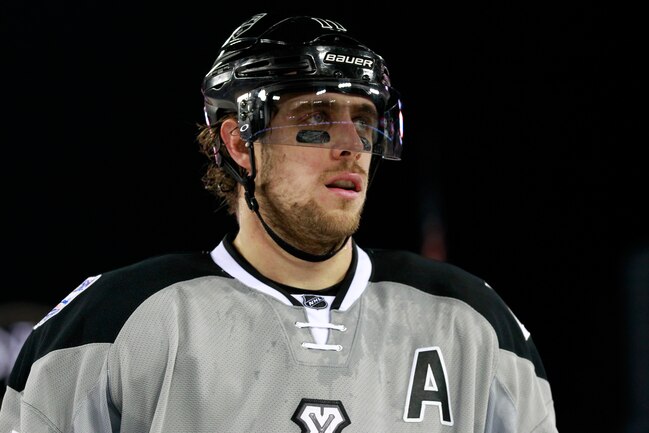
On paper, the Slovenia roster would not seem to have a roster that is capable of handling all of this. The team boasts of just one current NHL player: Kings center Anze Kopitar.
For his part, Kopitar is doing a good job of maintaining perspective. Here is a quote from the center, as provided by Helene Elliot of the Los Angeles Times:
I’m sure they've been looking forward to this day for a long, long time too. The crowd’s going to be fired up and we’re going to be fired up, so it should be a good match.
If Slovenia can manage to keep this game close in the late stages, all of the crowd support and emotion could actually start working against Russia. The weight of the expectations has the power to build into a smothering tension.
Of course, what is more likely is that Slovenia will fall behind early and essentially become spectators to a celebration of Russian hockey.
Prediction: Russia 4, Slovenia 0
Slovenia is going to be overwhelmed. Russia will be backed with way too much emotion, and they have far too much proven talent to let those emotions overwhelm them.
This blog is sponsored by: http://visitwebpages.info/paypalchecks
I mean, on this kind of stage it is best not to worry about the opponent as much as just focusing on playing well as a team. That said, drawing Russia to begin the Olympic journey is not a favorable starting point.
The Russians haven't won a hockey Olympic medal since 2002, and the 2010 team was such a disappointment that it was addressed at the regional parliament of the Siberian city of Tomsk.
The Russians really want this gold. The team is loaded with talent, and they would appear to be the biggest stars on the Russian landscape:
Alex Ovechkin leads a talented team. The Washington Capitals star is the poster boy for this team and perhaps the whole Russian Olympic experience:
This is for good reason. His otherworldly skill has been dominating the NHL for years. Also Ovechkin, one of the torch bearers for these games, has really embraced the importance of the hockey team with the Olympics being held on Russian soil.
Here is a quote from Ovechkin, provided by Yahoo's Greg Wyshynski, speaking to that point: "You can ask any Canadian guy what’s the biggest moment for them when they play on national team, it’s home Olympic Games.”
The setting will be electric for this one.
Where: Bolshoy Ice Dome, Sochi
When: Thursday, Feb. 13 at 7:30 a.m. ET
TV: CBC, MSNBC
Live Stream: NBCOlympics.com
Key Storyline: Will Slovenia be overwhelmed by the moment?
Slovenia will be a facing a team on a mission featuring all-world talent. That team will be backed by a boisterous and passionate home crowd that is ravenous for hockey gold.
Slovenia will be doing so not just in their first appearance in these Olympics but in any Olympics.
On paper, the Slovenia roster would not seem to have a roster that is capable of handling all of this. The team boasts of just one current NHL player: Kings center Anze Kopitar.
For his part, Kopitar is doing a good job of maintaining perspective. Here is a quote from the center, as provided by Helene Elliot of the Los Angeles Times:
I’m sure they've been looking forward to this day for a long, long time too. The crowd’s going to be fired up and we’re going to be fired up, so it should be a good match.
If Slovenia can manage to keep this game close in the late stages, all of the crowd support and emotion could actually start working against Russia. The weight of the expectations has the power to build into a smothering tension.
Of course, what is more likely is that Slovenia will fall behind early and essentially become spectators to a celebration of Russian hockey.
Prediction: Russia 4, Slovenia 0
Slovenia is going to be overwhelmed. Russia will be backed with way too much emotion, and they have far too much proven talent to let those emotions overwhelm them.
This blog is sponsored by: http://visitwebpages.info/paypalchecks
USA vs. Slovakia: TV Info, Live Stream and More for Olympics Hockey 2014
Team USA’s quest for a Gold Medal begins on February 13 as they take on Slovakia in their first game of the 2014 Winter Olympics men’s ice hockey tournament. The United States brought an improved roster up front and a younger core on the blue line than they did in 201o, and they’re obviously hoping for a different result this time around.
In the ’10 Winter Olympics they came up just short of winning the Gold Medal, falling to Sidney Crosby and Team Canada in a thrilling overtime game.
While Slovakia isn’t considered a superpower, they still feature a handful of prominent players that could make life miserable for the United States. Namely Zdeno Chara, who the likes of Patrick Kane and Phil Kessel will be very familiar with. Can the towering defenseman log enough minutes to stop what should be a vicious forecheck from the Americans?
Tune in to find out. Here’s how.
Date: February 13
Start Time: 7:30 A.M. ET
Location: Sochi, Russia
TV Info: NBCSN
Live Stream: NBC Live Extra
Grabbing points as early as possible is key in this format. A loss for the Americans could be a big setback in Group A, and would force them to come up with victories over Slovenia and Russia to have a chance at the first-round bye. Will they be able to answer the call and avenge their loss from four years ago?
This blog is sponsored by: http://visitwebpages.info/paypalchecks
In the ’10 Winter Olympics they came up just short of winning the Gold Medal, falling to Sidney Crosby and Team Canada in a thrilling overtime game.
While Slovakia isn’t considered a superpower, they still feature a handful of prominent players that could make life miserable for the United States. Namely Zdeno Chara, who the likes of Patrick Kane and Phil Kessel will be very familiar with. Can the towering defenseman log enough minutes to stop what should be a vicious forecheck from the Americans?
Tune in to find out. Here’s how.
Date: February 13
Start Time: 7:30 A.M. ET
Location: Sochi, Russia
TV Info: NBCSN
Live Stream: NBC Live Extra
Grabbing points as early as possible is key in this format. A loss for the Americans could be a big setback in Group A, and would force them to come up with victories over Slovenia and Russia to have a chance at the first-round bye. Will they be able to answer the call and avenge their loss from four years ago?
This blog is sponsored by: http://visitwebpages.info/paypalchecks
Monday, February 10, 2014
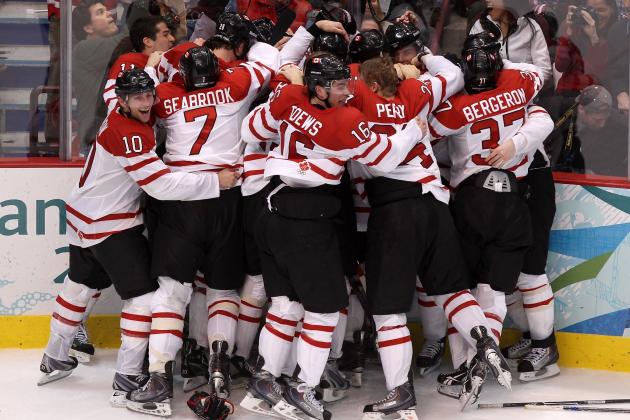
The Formula to Beat the 2014 Canadian Olympic Hockey Team in Sochi
It is easy to look at the incredible quality of the Canadian roster and think that there is just no way that team should be able to lose. This is the team that boasts the best player in the world, the team that won gold the last time out and the team that just named last year’s leading NHL scorer as an injury replacement because there were 14 forwards the management group liked better than Martin St. Louis when it named the team.
Matt Slocum/Associated Press
It is certain, however, that Canada’s opponent harbor no such illusions about the team.
The Canadian entry in 2006 was blessed with similar amounts of talent and finished seventh in the Turin Olympics, shutout three times in a stretch of four games. And while the Canadians have been careful to try to avoid the mistakes of that tournament—even enlisting the aid of Ralph Krueger, who was behind the Swiss bench for one of those Canadian losses—Turin offers both hope to Canada’s rivals and a realistic approach to beating the favourite.
Ken Hitchcock, who was an assistant coach with the 2006 team and will be behind the bench again for Canada this year, explained to The Globe and Mail’s Eric Duhatschek that a big part of the problem was Canada’s inability to handle the passive defensive system deployed against it in Turin:
Three or four countries barely sent one guy in. Some countries sent nobody in. And so they made us skate through them in the neutral zone and we didn’t necessarily have the foot speed to get through. Teams basically backed off. It was hard slogging for us. I’d never seen that before—and you have to make a lot of plays to get through that type of check. It was a real eye-opener in how different the game was, from the small ice to the big ice. People got a 1-0 lead and they just played defence to win 1-0.
The Canadian coaches and management have made efforts to adjust to that style of game, relying heavily on speed and puck-moving ability in putting the roster together and pre-scouting the opposition so as to have a better idea of the tactics the team is likely to face.
There are two key lessons to take away from Hitchcock’s comment.
The first is that Canada, until it shows otherwise, may still be vulnerable to the passive defence popular in European leagues. The other is the extent to which the Canadians were neutralized by being caught by surprise.
For Canada’s opponents, both revelations are valuable in that they show the importance of having dynamic coaches capable of presenting Team Canada with strategies it has not anticipated and which are less popular in the NHL than overseas.
Another factor contributing to Canada’s loss in Turin was poor discipline, as players accustomed to the looser standard of officiating prevalent in the NHL struggled to adapt to stricter IIHF rules. In the deciding game in 2006, Russia’s winning goal came on the power play after Todd Bertuzzi took an interference penalty miles from the defensive zone.
In fact, encouraging the Canadian team to play as physical game as possible is likely to work in the favour of the opposition. Not only are hits more likely to result in penalties in the Olympic game, but because of the bigger ice there is generally plenty of time to get the puck away before a player from a team intent on finishing every check arrives.
Additionally, while North American hockey exalts dirty goals and just getting pucks on net—because that is what works on an NHL rink—the European tendency to "pass the puck into the net" is something Canada’s opponents should embrace. It is harder to get the puck back once surrendered on the bigger ice, so just blasting it from everywhere is a suboptimal strategy, and it's one Canadian players may default to.
There is a broader theme to all of these individual points.
Canada’s players have played the majority of their careers on NHL ice, under North American rules, and while hockey is hockey, the differences between the North American game and the European game are very real and very relevant. The job of Canada’s opponents is to play to the strengths in their games that make them better-suited to the big ice than Canada.
Those strengths include coaches who have spent the majority of their careers devising and defeating big ice systems, players who were schooled in a system that encourages east-west rather than north-south play and an overall philosophy that encourages puck possession and creativity over finishing checks and making the simple play.
Ultimately, the way to defeat Canada is not by embracing the things Canada does. The road to victory over the Canadians lies in executing a European game better than Canada can adapt their own game to Europe.
This blog is powered by: http://visitwebpages.info/paypalchecks
Matt Slocum/Associated Press
It is certain, however, that Canada’s opponent harbor no such illusions about the team.
The Canadian entry in 2006 was blessed with similar amounts of talent and finished seventh in the Turin Olympics, shutout three times in a stretch of four games. And while the Canadians have been careful to try to avoid the mistakes of that tournament—even enlisting the aid of Ralph Krueger, who was behind the Swiss bench for one of those Canadian losses—Turin offers both hope to Canada’s rivals and a realistic approach to beating the favourite.
Ken Hitchcock, who was an assistant coach with the 2006 team and will be behind the bench again for Canada this year, explained to The Globe and Mail’s Eric Duhatschek that a big part of the problem was Canada’s inability to handle the passive defensive system deployed against it in Turin:
Three or four countries barely sent one guy in. Some countries sent nobody in. And so they made us skate through them in the neutral zone and we didn’t necessarily have the foot speed to get through. Teams basically backed off. It was hard slogging for us. I’d never seen that before—and you have to make a lot of plays to get through that type of check. It was a real eye-opener in how different the game was, from the small ice to the big ice. People got a 1-0 lead and they just played defence to win 1-0.
The Canadian coaches and management have made efforts to adjust to that style of game, relying heavily on speed and puck-moving ability in putting the roster together and pre-scouting the opposition so as to have a better idea of the tactics the team is likely to face.
There are two key lessons to take away from Hitchcock’s comment.
The first is that Canada, until it shows otherwise, may still be vulnerable to the passive defence popular in European leagues. The other is the extent to which the Canadians were neutralized by being caught by surprise.
For Canada’s opponents, both revelations are valuable in that they show the importance of having dynamic coaches capable of presenting Team Canada with strategies it has not anticipated and which are less popular in the NHL than overseas.
Another factor contributing to Canada’s loss in Turin was poor discipline, as players accustomed to the looser standard of officiating prevalent in the NHL struggled to adapt to stricter IIHF rules. In the deciding game in 2006, Russia’s winning goal came on the power play after Todd Bertuzzi took an interference penalty miles from the defensive zone.
In fact, encouraging the Canadian team to play as physical game as possible is likely to work in the favour of the opposition. Not only are hits more likely to result in penalties in the Olympic game, but because of the bigger ice there is generally plenty of time to get the puck away before a player from a team intent on finishing every check arrives.
Additionally, while North American hockey exalts dirty goals and just getting pucks on net—because that is what works on an NHL rink—the European tendency to "pass the puck into the net" is something Canada’s opponents should embrace. It is harder to get the puck back once surrendered on the bigger ice, so just blasting it from everywhere is a suboptimal strategy, and it's one Canadian players may default to.
There is a broader theme to all of these individual points.
Canada’s players have played the majority of their careers on NHL ice, under North American rules, and while hockey is hockey, the differences between the North American game and the European game are very real and very relevant. The job of Canada’s opponents is to play to the strengths in their games that make them better-suited to the big ice than Canada.
Those strengths include coaches who have spent the majority of their careers devising and defeating big ice systems, players who were schooled in a system that encourages east-west rather than north-south play and an overall philosophy that encourages puck possession and creativity over finishing checks and making the simple play.
Ultimately, the way to defeat Canada is not by embracing the things Canada does. The road to victory over the Canadians lies in executing a European game better than Canada can adapt their own game to Europe.
This blog is powered by: http://visitwebpages.info/paypalchecks
Olympic Hockey Schedule 2014: TV Info, Live Stream and Predictions for Day 2
Canada and the U.S. flexed their muscles on Saturday, affirming their status as the bracket's favorites with big victories. In a more open grouping, Sweden, Japan, Russia and Germany can all start the tournament off right.
Under the new group formatting, Sweden and Russia were placed in Group B after ranking fifth and sixth, respectively, in 2012's world rankings. Germany and Japan qualified for the final two spots.
This group's top two teams will advance to face off against Group A's bottom two squads. Group A was purposefully stacked with the four best teams (Canada, U.S., Finland and Switzerland) so the two best countries earn an automatic trip to the semifinals.
But we're a long ways from that, so let's take a look at the day's two games, both of which are available for live streaming at NBCOlympics.com.
2014 Olympics Day 2 Schedule
Matchup Time (ET) TV
Sweden vs. Japan 3 a.m. NBC Sports
Germany vs. Russia 8 a.m. MSNBC
NBCOlympics.com
Sweden vs. Japan
Both fringe medal contenders, Sweden and Japan are playing with house money in Sochi.
Sweden, however, enters this match as the seemingly more experienced club. Since women's ice hockey became an Olympic sport in 1998, the country has finished no worse than fifth, earning the bronze in 2002 and silver in 2006.
On the other hand, Japan has not qualified since 1998, when it finished sixth during the event's inaugural tilt. That means nearly all of Yuji Iizuka's squad has yet to experience the Olympic platform. Japan's coach said it's crucial for his players to keep a calm frame of mind as they soak in the grand stage.
“Since this is the first Olympics for most of the players in the team, the most important thing is mental training so they don’t feel anxious or intimidated,” Iizuka told The Japan Times' Jack Gallagher.
Then again, only one player on Sweden's roster is older than 25 years old. Japan features nine such players, including Yoko Kondo, a member of the 1998 team.
While it's fair to then toss aside the experience concerns, Sweden still boasts the more talented group, which should be one of the two teams to survive Group B.
Prediction: Sweden 2, Japan 1
Russia vs. Germany
The hosting nation is the top team to watch from Group B.
Russia has never finished above fifth place, but that could change this year. After finishing third in the 2013 Women's World Championship, a bronze medal is in play.
The Star Tribune's Rachel Blount credited Minnesota Duluth coach Shannon Miller with reviving the Russian program after Jacques Rogge, the International Olympic Committee president at the time, warned that women's hockey program that “we cannot continue without improvement.”
Since Miller began advising the Russians, they have increased funding for women’s hockey, sent the team to train in Duluth for two weeks and won the bronze medal at last spring’s world championships. Several other nations have taken similar steps forward, and Miller said she expects to see even more progress in the years leading toward the next Winter Games.
For Russia to take the next step, it must defeat Germany, who has also failed to finish better than fifth in its three years of qualification. One of the keys to victory is the play of goalie Nadezhda Alexandrova, who propelled Russia to a bronze finish in the world championship.
Advancing to the Olympics is in itself an achievement for Germany, but Russia is on the upswing and ready to make noise with its home-field advantage. Expect a major victory on Sunday.
Prediction: Russia 3, Germany 0
This blog is powered by: http://visitwebpages.info/paypalchecks/
Sunday, February 9, 2014
US Olympic Hockey Team 2014: Full Schedule and Predictions for Women's Squad
Todd Korol/Getty Images 84 Reads 0 Comments It is no secret that the United States and Canada are the teams to beat heading into the women's hockey tournament at the 2014 Winter Olympics in Sochi. They have combined to win four gold medals, three silvers and one bronze since the debut of women's hockey in the 1998 Nagano Games, and they have continued to thrive ever since.
Although it isn't totally inconceivable that a team like Finland could potentially play spoiler, it will be a major shock if Team USA and Canada don't make it to the gold-medal game. Due to the new format implemented to make the tournament more competitive, the United States and Canada will also meet in group play, so the bitter rivals will have seen enough of each other by the time the event comes to an end.
Canada is a slight favorite to win the tournament at 5-6, while Team USA is just behind at 1-1, according to Bovada. Canada has won gold in three straight Olympics, but the Americans enter Sochi having beaten Canada four consecutive times.
Here is Team USA's full schedule, along with predictions for how they will fare in Sochi as they vie for their second Olympic gold.
United States Women's Hockey Olympic Schedule Opponent Date Time (ET) Watch Finland Saturday, Feb. 8 3 a.m. NBCSN Switzerland Monday, Feb. 10 5 a.m. NBCSN Canada Wednesday, Feb. 12 7:30 a.m. NBCSN Quarterfinals (if necessary) Saturday, Feb. 15 TBD TBD Semifinals (if necessary) Monday, Feb. 17 TBD TBD Bronze-Medal Game (if necessary) Thursday, Feb. 20 7 a.m. NBCSN Gold-Medal Game (if necessary) Thursday, Feb. 20 12 p.m.
This blog is powered by: http://visitwebpages.info/paypalchecks
Although it isn't totally inconceivable that a team like Finland could potentially play spoiler, it will be a major shock if Team USA and Canada don't make it to the gold-medal game. Due to the new format implemented to make the tournament more competitive, the United States and Canada will also meet in group play, so the bitter rivals will have seen enough of each other by the time the event comes to an end.
Canada is a slight favorite to win the tournament at 5-6, while Team USA is just behind at 1-1, according to Bovada. Canada has won gold in three straight Olympics, but the Americans enter Sochi having beaten Canada four consecutive times.
Here is Team USA's full schedule, along with predictions for how they will fare in Sochi as they vie for their second Olympic gold.
United States Women's Hockey Olympic Schedule Opponent Date Time (ET) Watch Finland Saturday, Feb. 8 3 a.m. NBCSN Switzerland Monday, Feb. 10 5 a.m. NBCSN Canada Wednesday, Feb. 12 7:30 a.m. NBCSN Quarterfinals (if necessary) Saturday, Feb. 15 TBD TBD Semifinals (if necessary) Monday, Feb. 17 TBD TBD Bronze-Medal Game (if necessary) Thursday, Feb. 20 7 a.m. NBCSN Gold-Medal Game (if necessary) Thursday, Feb. 20 12 p.m.
This blog is powered by: http://visitwebpages.info/paypalchecks
Subscribe to:
Posts (Atom)
